A customer onboarding checklist for local service businesses
Build a practical customer onboarding checklist with clear owners, preparation steps, and evidence that a local business is ready for the first job.
Quick answer
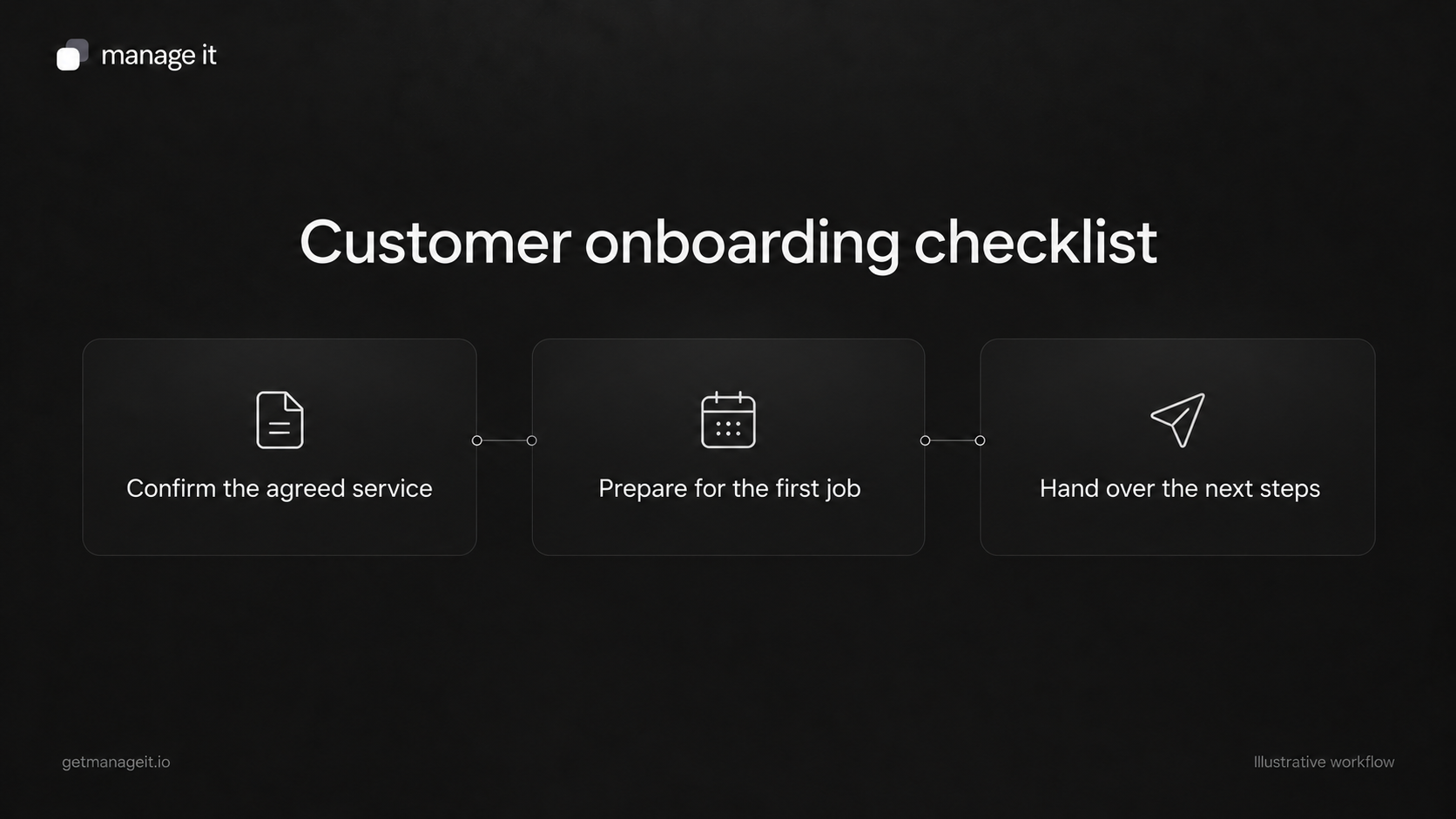
Start onboarding when the customer agrees to the service, and define what must be ready before work begins.
Give every checklist item an owner, a due point, and a visible way to confirm completion.
Connect the customer record, agreed scope, appointment, documents, and preparation instructions without asking for the same information repeatedly.
Your client has won a new customer. Now someone has to confirm the service, collect any missing information, arrange the first visit, and make sure the team knows what was agreed.
This article covers the business onboarding its customer. As the agency, you help design and set up that handoff. A useful checklist tells staff what to do and how to know it has happened.
Define the start and finish
Choose a specific starting event. “The customer accepted the service proposal” is clearer than “a new lead arrived.” An inquiry may still need assessment before the business is ready to make arrangements.
Then define the finish. For a recurring cleaning service, it might be: the first visit is confirmed, staff have the agreed scope, necessary preparation has been communicated, and one person owns any unresolved question.
Keep sales follow-up separate from this stage. The lead follow-up guide covers handling an inquiry. Onboarding begins once the business is ready to organize the agreed work.
Use a checklist with evidence
Copy the following structure into the client's working system. Add the actual staff member and due point to each item; the examples are proposed responsibilities, not completed work.
1. Confirm the accepted service
Owner: The person who agreed the work with the customer.
Due: Before booking or preparing the first job.
Evidence: The current scope, service reference, price arrangement, and any exclusions are available to the team.
Check that the staff version matches what the customer saw. A change agreed on the phone needs to reach the people doing the work.
2. Check the customer record
Owner: The person handling customer administration.
Due: Before sending documents or appointment messages.
Evidence: The correct contact details are present, with a clear link to the relevant job or service.
Look for an existing customer before creating another record. If a customer uses more than one email address, make sure staff understand which one receives the relevant communication.
3. Collect missing preparation information
Owner: The person who plans the service.
Due: Early enough to resolve a missing answer before the visit.
Evidence: The required details have been received and reviewed, not merely requested.
For a cleaner, this might include the service address, property details that affect the agreed work, and suitable arrangements for arrival. Ask for sensitive access information only through the business's appropriate process. The intake form guide helps decide what to ask and when.
4. Confirm the appointment
Owner: The person managing the diary.
Due: Before staff or the customer rely on the date.
Evidence: The booking has the correct status, service, date, time, and location, and the customer has received the corresponding message.
A request awaiting approval is still a request. Don't have the welcome message promise a confirmed visit while staff are deciding whether they can take the job.
5. Complete any agreed document or payment stage
Owner: The staff member responsible for documents or billing.
Due: At the point agreed with the customer.
Evidence: The required document or payment stage shows the relevant completed status.
Use the actual arrangement. A deposit, a signed agreement, and a first invoice are separate checks; none should be added just because it appears on a generic checklist.
6. Send the first-visit instructions
Owner: The customer's named contact.
Due: With enough time for the customer to prepare.
Evidence: Instructions include the next action, practical preparation, and a monitored route for questions.
Keep the message short. If the customer needs to do one thing, make that action prominent instead of burying it under a tour of every service the business offers.
7. Review readiness and exceptions
Owner: The person responsible for the first job.
Due: Before the work begins.
Evidence: Every required item is complete, or an unresolved item has a named owner and a decision about whether work can proceed.
Connect the records in ManageIt
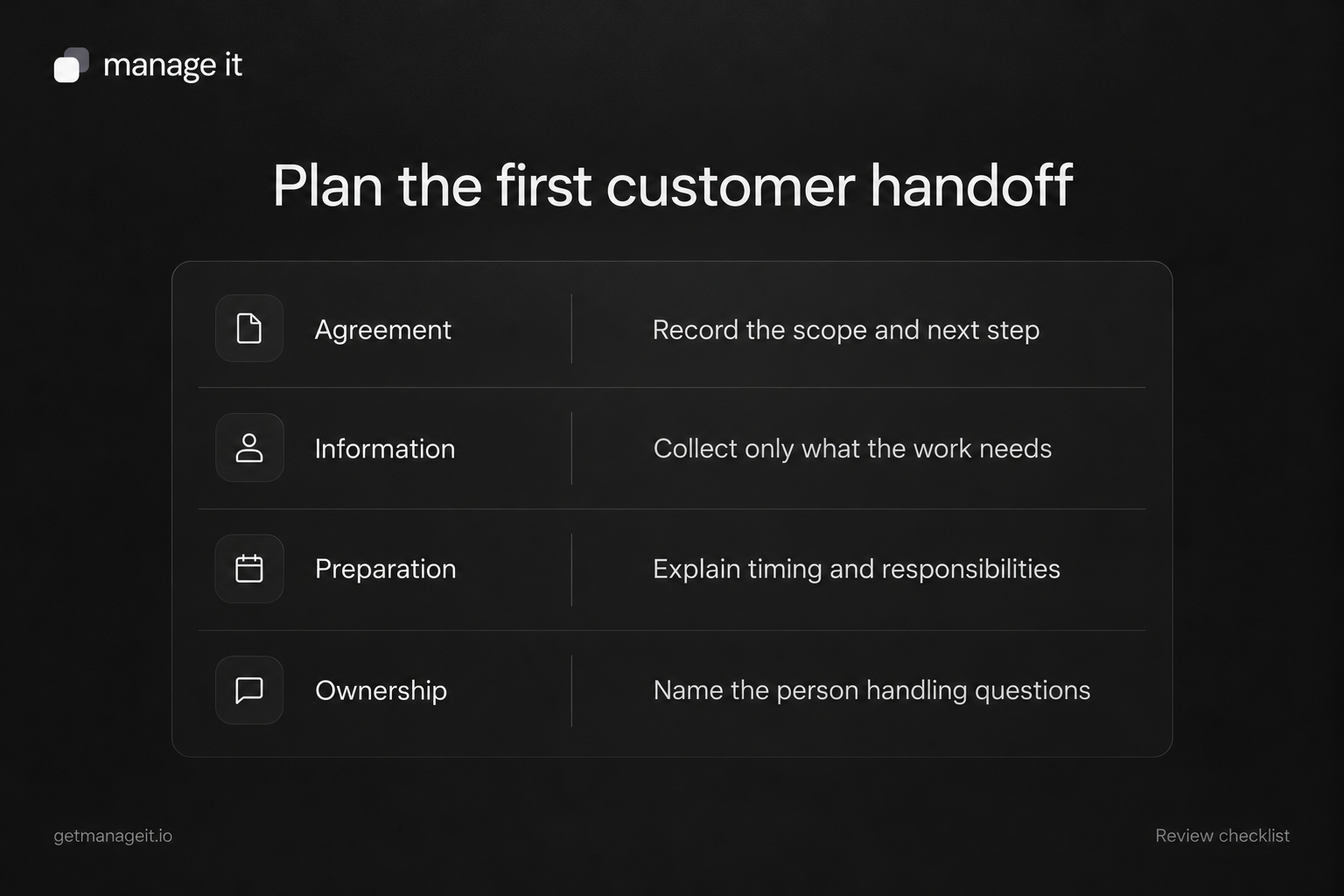
ManageIt's custom entities let you define records for business-specific work, such as a property or service job. Relationship fields can link those records to contacts. That gives the checklist a place to refer to the customer and the work without forcing every job detail into the contact's name or notes.
Form record-creation rules can create a contact and a related custom record from one submission, with field mappings and relationships. Plan the structure before configuring it, then test what happens for a returning customer.
Use documents and bookings for the stages they represent. A submitted form should not be treated as proof that an appointment is confirmed, an agreement signed, or an invoice paid.
Test the handoff with the people doing the work
Asana's onboarding guidance separates ownership, preparation, and progress checks. For a small service business, the same questions can fit on a short checklist; a large implementation plan may be unnecessary.
Walk through one fictional customer with the administrator and the person delivering the service. Remove a required detail, change the appointment, and introduce a customer question. Ask where each issue appears and who takes over.
Then have a staff member explain the process back using the records on screen. If they need to ask the agency what “ready” means, improve the checklist before adding more automation.
The result should be a repeatable first-customer experience: the business knows what is happening, the team has what it needs, and the customer knows the next step.