Overdue invoice reminder emails: templates and checks for your clients
Quick answer
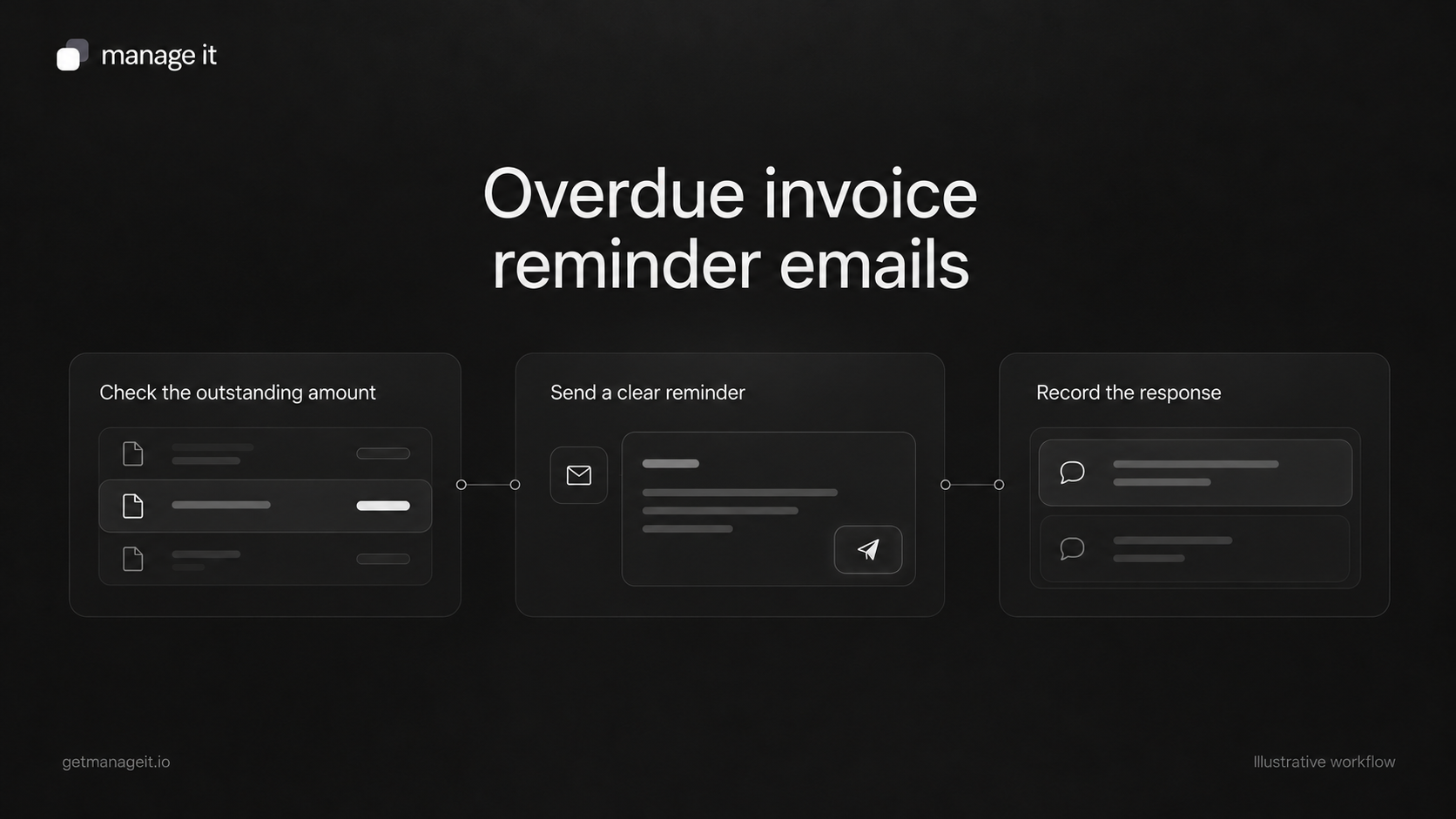
Check the current outstanding balance and recent conversation before sending an overdue reminder.
Include the invoice reference, due date, remaining amount, and verified payment route in a short, neutral message.
Stop routine follow-up when the relevant overdue balance is fully paid, or pause it while a payment or customer question is being checked.
Write useful overdue invoice reminders with a checked balance, a clear payment route, and a process for already-paid invoices and customer questions.
The most important part of an overdue invoice reminder happens before anyone writes the email: checking whether the request is still accurate.
Your business client may accept online payments, cash, and bank transfers. A reminder based on an incomplete record can ask a customer to pay again or quote the wrong balance. Help the business establish a quick review, then use consistent wording for the message.
The templates below are original examples. Replace bracketed text with the client's actual details; these are not built-in software variables.
First overdue reminder
Subject: Invoice [invoice number]: [remaining amount] outstanding
Hi [first name],
I'm following up on invoice [invoice number] for [service or job reference], which was due on [date]. Our records currently show [remaining amount and currency] outstanding.
You can review the invoice and payment details at [verified invoice link].
If you've already paid, please let us know the payment date and reference so we can check our records. If you have a question about the invoice, reply here and [responsible person] will help.
Thanks,
[staff name]
[business name]
Keep the wording factual. Avoid guessing why the customer hasn't paid or adding urgency that the business has not agreed to.
Reminder after a partial payment
Subject: Remaining balance for invoice [invoice number]
Hi [first name],
Thank you for the [amount and currency] payment recorded on [date] against invoice [invoice number].
The remaining balance is [remaining amount and currency], due on [applicable due date]. You can view the updated invoice at [verified invoice link].
If another payment is on its way or the details don't look right, reply here so we can check before sending another reminder.
Thanks,
[business name]
Only use the overdue version of this message when the remaining amount is actually overdue. A later installment may have its own future due date. The full invoice total is not automatically the amount due today.
When the customer says they already paid
Subject: Checking your payment for invoice [invoice number]
Hi [first name],
Thanks for letting us know. We're checking the payment against invoice [invoice number].
Please send the payment date and reference through [monitored route] if you haven't already. [Responsible person] will update you after checking the record.
Thanks,
[business name]
Pause the routine reminder while the responsible person reconciles the payment. Ask only for information needed to identify the transaction; the business does not need the customer's full card details in an email.
When there is a question about the invoice
Subject: Your question about invoice [invoice number]
Hi [first name],
Thanks for flagging [brief, neutral description of the question]. [Responsible person] is reviewing it against [the relevant job record or agreed scope].
We'll contact you through [agreed route] with the next update. If there's anything else we should check, please reply here.
[staff name]
Use the business's actual response commitment if one has been agreed. Don't manufacture a resolution date or use a payment reminder to decide a dispute.
Check before the next message
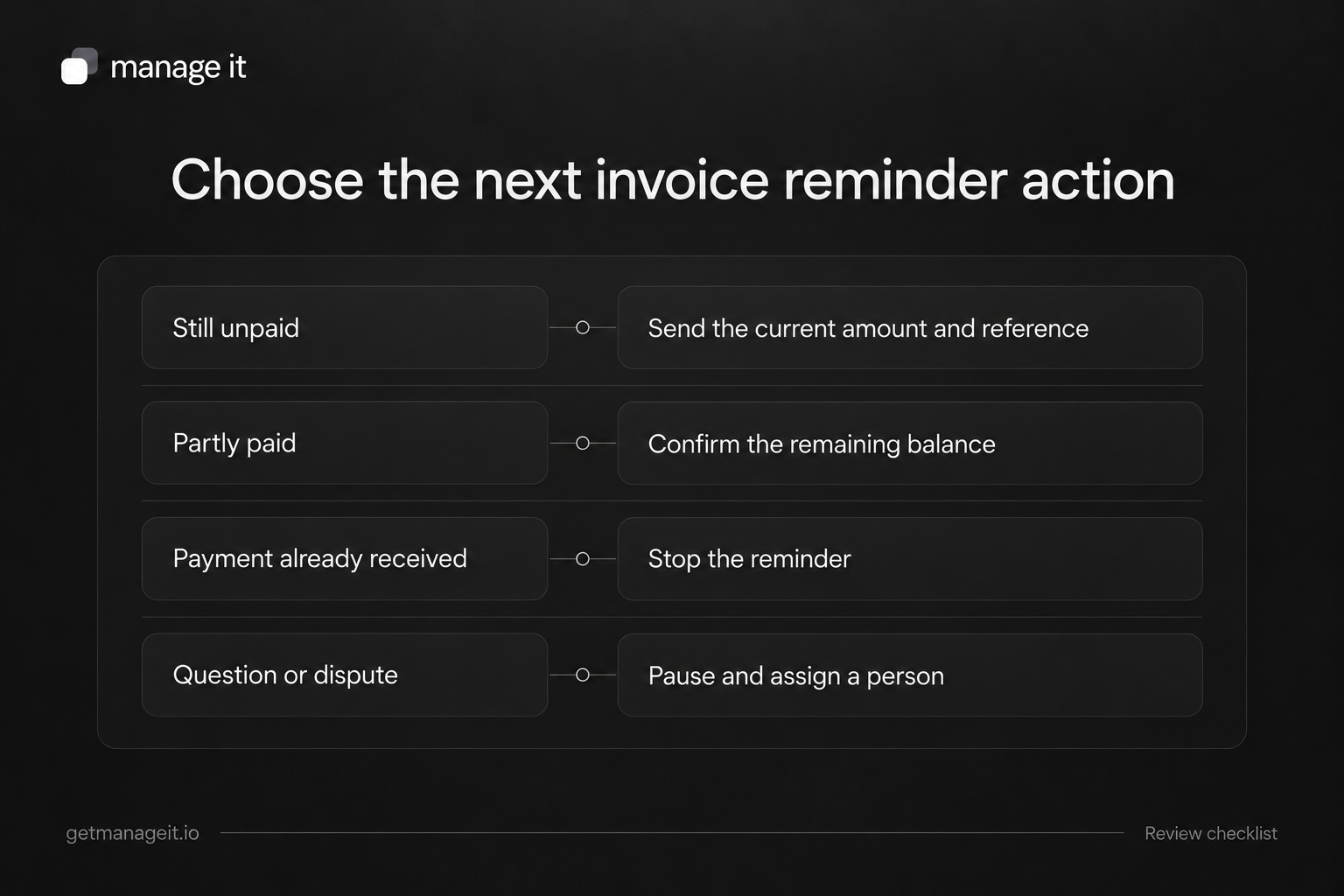
Before every follow-up, the business should be able to answer:
What amount is outstanding now?
Which payment or installment is due, and when?
Have any payments arrived outside the online system?
Has a refund, correction, or other adjustment changed the record?
Has the customer replied, questioned the invoice, or agreed a different next step?
Who is responsible if the record and the customer's account disagree?
Stripe supports configurable invoice reminders, but a configurable schedule is not a universal recommendation for how often to contact someone. Choose a sequence with the client and provide a way to stop it when the situation changes.
Configure reminders around current information
ManageIt's payment schedules include reminder settings before the due date, on the due date, and after a grace period. The automation condition catalog also includes full-payment and overdue checks for document workflows.
If you use a delayed automation, place the relevant eligibility check before the sending action, then test a payment arriving during the wait. The documentation alone doesn't establish whether every check reloads the latest state. Inspect the actual run and message before making the workflow live for the client.
Manual payments matter here. ManageIt can record payments received outside Stripe, but someone must enter the accurate amount against the correct document. Assign that responsibility as part of the setup.
Test four cases with the client
Use controlled sample invoices for an unpaid balance, a partial payment, a full payment received before the reminder, and a customer question. Record the expected action and the actual result for each.
Also test the reply route. A well-written invitation to reply is useless if the response lands in an inbox nobody checks.
Keep the initial invoice message separate from overdue follow-up; use the invoice email templates for first delivery. If late payment is a recurring problem, review the whole billing process before adding more messages.